Equine Training Philosophy
Horseman’s Creed: The Horse Is Never Wrong (and what does this REALLY mean?)
Adaptive EQ’s equine training philosophy is grounded in the principle that the horse is never wrong. Read about Euki here, or see examples of her work from her sampling of featured transformations. To see an example of how Adaptive EQ can transform your horse, please read Euki’s article, “In Defense of the Average Horse”.
The Blame Game. It’s a common enough malady we’ve all seen, and we’ve certainly all heard it at some point during our instruction. So whose fault is it? Is it ours? Is it the horse’s? Perhaps it’s his first owner, his second, or even his fourth owner that is to blame?
All of the above may be the case, but whether the problem is a jump refusal, laziness, skittishness, or something grander such as, “it is the horse’s fault that I am not more skilled or more graceful,” placing blame never produces the result you set out to achieve.
Avoiding the Blame Game
In place of blame, we must quiet the ego and ask ourselves, “what is the source of this misunderstanding?” A foundational weakness in the rider or horse often improves only through care, attention, and consistent practice. We call this being impeccable with our practice.
A case in point: if you struggle with a specific issue but a more advanced rider can make the issue improve or go away entirely, this insight has rewarded you with an opportunity to improve your technique.
Addressing these challenges requires patience and problem-solving. Buying a new horse to avoid them will only create a temporary solution.
Foundational Deficiencies
We can usually trace ongoing problems back to foundational deficiencies in balance or strength. Sometimes that deficiency lies in the horse and sometimes that deficiency lies in the rider. As we develop (or re-develop) these two qualities of balance and strength, Adaptive Development EQ builds upwards until we find the source of the block that is keeping you from achieving the results you desire. With diligence, all other traits of fine riding follow, including confidence, quietness, sensitivity, and timing.
Are underlying issues quietly affecting your horse’s ability to succeed?
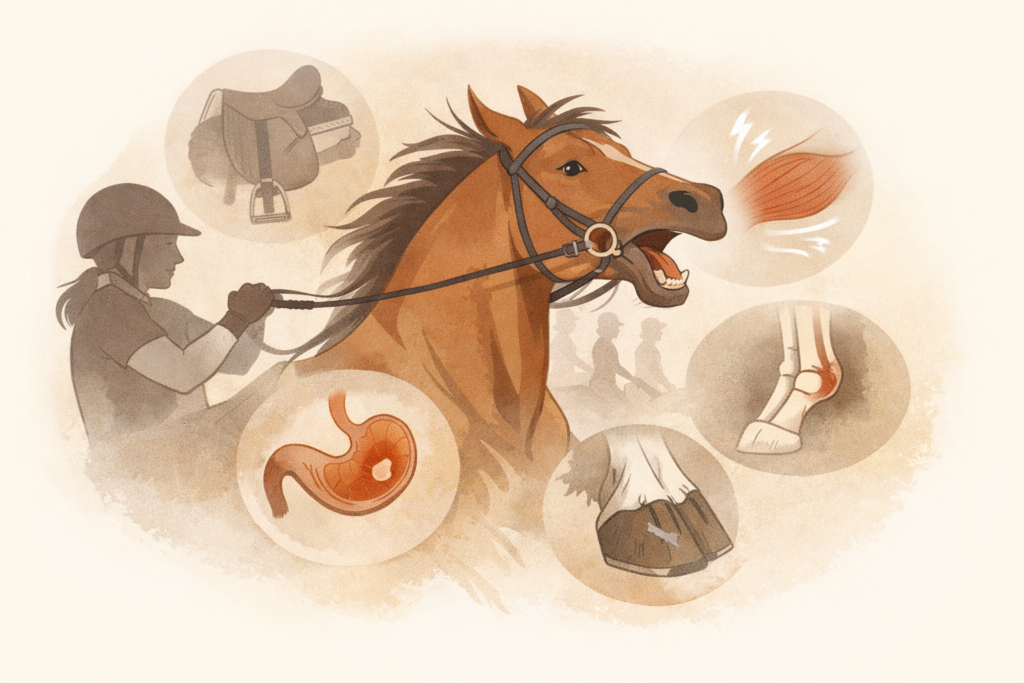
Remember, according to the old masters, your horse is never wrong. Let’s elucidate this further, by noting that it is also extremely unlikely that your horse is inherently bad, cheap, mean, dumb, clumsy, (insert your choice of negative trait). Ongoing problems in horses arise because of underlying, often hidden issues. Adaptive EQ addresses all of these, including:
If you take nothing else with you to the barn but this one thought, “the horse is not to blame,” then you will have already improved your horsemanship without ever having to lift a finger. For it is through this thoughtful practice, that you begin to hear the very quiet voice of your horse. What you discover within (both yourself and your horse) will transform your frustrations into joys, reward you with knowledge gained, and open the door to a higher level of partnership and achievement.

How Adaptive EQ supports Lasting Change
Our equine training philosophy draws from a time-honored adage familiar to many horsemen: the horse is never wrong. Simple, yet profound, this belief shapes every interaction at Adaptive EQ, reminding us to look beyond symptoms and uncover the true source of challenges. From this foundation, equestrians develop a deeper understanding of the horse’s nature, setting the stage for growth, connection, and lasting success.
If you’d like to join the Adaptive EQ community, we invite you to reach out.
Each program begins with a conversation to understand your horse, your goals, and whether this is the right fit for you.